Table of Contents
- 1. Why AI Sales Agents Are Taking Over
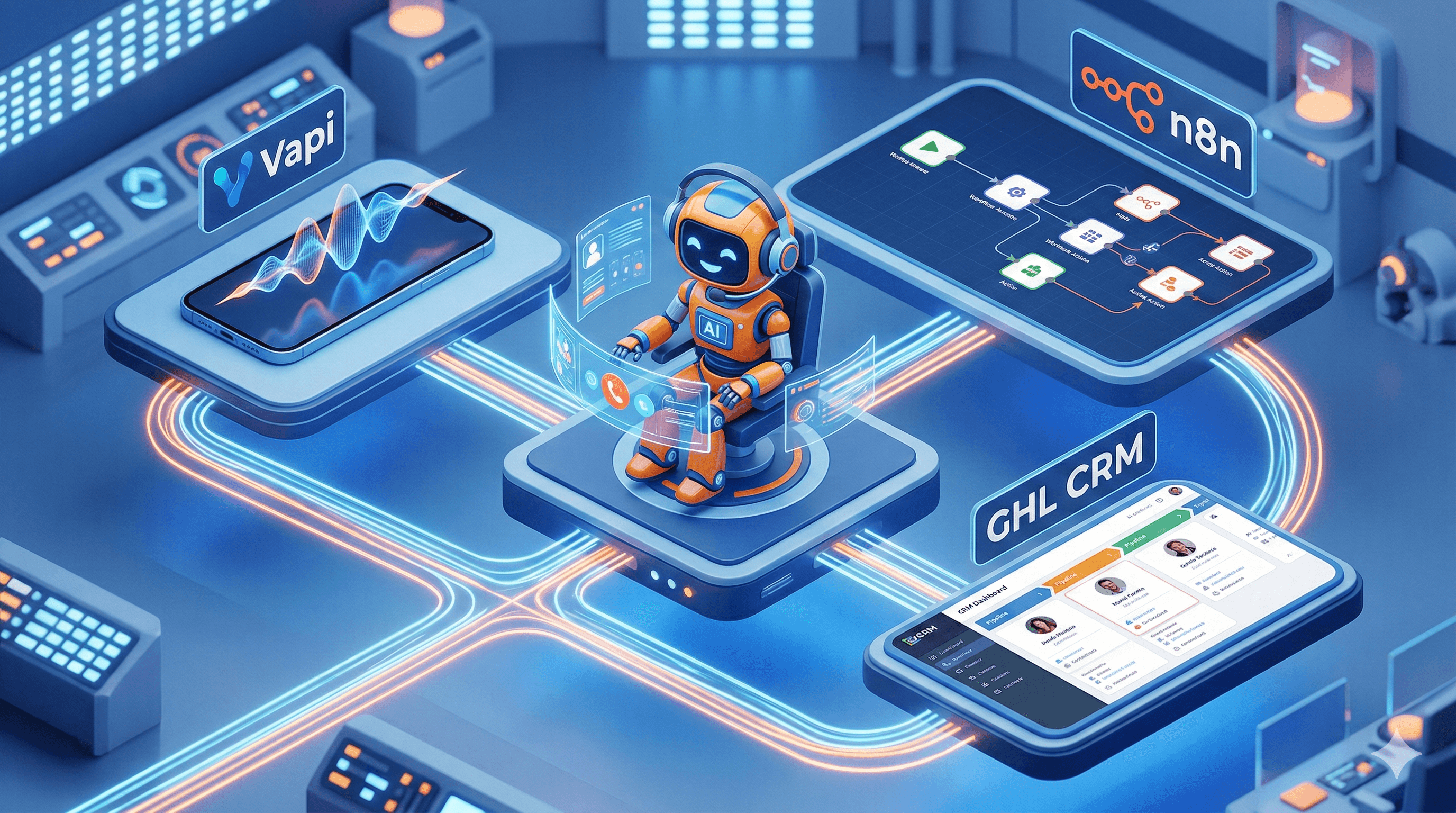
- 2. The Stack Explained: Vapi + n8n + GHL
- 3. Vapi — The Voice Layer
- 4. n8n — The Automation Backbone
- 5. GoHighLevel — The CRM & Follow-Up Engine
- 6. How They Work Together: The Full Flow
- 7. Cost Breakdown: What This Stack Actually Costs
- 8. Alternative Stacks Worth Considering
- 9. Getting Started: Your First AI Sales Agent
- 10. Is It Worth It? ROI Analysis
Why AI Sales Agents Are Taking Over
If you spend any time on Reddit's r/SaaS, r/Entrepreneur, or r/AIAutomation communities, you've noticed the explosion of interest in AI sales agents. Posts about automated outbound calling, AI-powered lead qualification, and voice bots that book appointments are routinely hitting the front page — and for good reason. The technology has crossed a threshold where it actually works.
The business case is straightforward: most small businesses lose 40-60% of inbound leads because nobody answers the phone fast enough. A potential customer calls, gets voicemail, and moves on to the next provider. By the time a sales rep calls back (often hours or days later), the prospect has already signed with a competitor. AI sales agents solve this by answering every call instantly, 24 hours a day, 7 days a week.
Beyond just answering calls, modern AI sales agents can qualify leads by asking the right questions, schedule appointments directly on your calendar, send follow-up texts and emails, and update your CRM — all without human intervention. They don't take sick days, don't need training on product updates (you just update the prompt), and they cost a fraction of a full-time sales development rep.
The numbers back this up. Businesses deploying AI voice agents report 30-50% increases in booked appointments and response times dropping from hours to under 10 seconds. In industries like roofing, HVAC, dental, legal intake, and real estate — where speed-to-lead is everything — that's the difference between a $0 and a $5,000+ customer.
But here's the challenge: building an AI sales agent isn't a one-tool solution. You need a voice layer, an automation backbone, and a CRM to manage everything downstream. That's where the Vapi + n8n + GoHighLevel stack comes in — the combination that's emerged as the go-to architecture for agencies and small businesses building AI sales systems in 2026.
Tool Scores Overview
The Stack Explained: Vapi + n8n + GHL
Building a production-quality AI sales agent requires three core capabilities: voice handling (answering and making calls with natural conversation), workflow automation (routing data between systems and triggering actions), and CRM management (tracking leads, managing pipelines, and automating follow-up sequences). Each tool in this stack handles one of those layers exceptionally well.
| Layer | Tool | Role |
|---|---|---|
| Voice & Conversation | Vapi | Handles inbound/outbound calls, speech-to-text, LLM reasoning, text-to-speech — the "brain" and "mouth" of your agent |
| Automation & Logic | n8n | Orchestrates workflows between Vapi, GHL, calendars, and any other API — the "nervous system" routing data |
| CRM & Follow-Up | GoHighLevel | Manages contacts, pipelines, automated SMS/email sequences, and appointment scheduling — the "memory" and follow-up engine |
Why this specific combination? Because each tool is best-in-class for its layer while remaining affordable and well-documented. Vapi is the most developer-friendly voice AI platform with the best latency numbers. n8n is the most flexible automation tool with a generous free tier and self-hosting option. GoHighLevel is the dominant CRM for agencies and service businesses, with built-in appointment booking, SMS, and email marketing.
The integration between these three is well-established. There are hundreds of community templates, YouTube tutorials, and agency playbooks using this exact stack. That means when you hit a wall, you'll find answers quickly — which matters enormously when you're building production systems for real businesses.
This stack also scales gracefully. You can start with a single AI agent handling inbound calls for one business, then expand to outbound campaigns, multi-location routing, and sophisticated lead scoring — all without ripping out and replacing components.
Vapi — The Voice Layer
Vapi is the voice AI platform that handles everything related to the actual phone conversation. When a call comes in (or your agent dials out), Vapi manages the entire pipeline: receiving audio, converting speech to text, sending that text to an LLM for reasoning, generating a response, converting it back to speech, and streaming it back to the caller — all in real time with sub-second latency.
What makes Vapi stand out in 2026 is its developer-first architecture. You configure your agent with a system prompt (just like ChatGPT), choose your speech-to-text provider (Deepgram is the default and fastest), select your LLM (GPT-4o, Claude, Gemini, or open-source models), and pick a voice from providers like ElevenLabs, PlayHT, or Cartesia. Every component is swappable, giving you fine-grained control over quality, speed, and cost.
Key Vapi capabilities for sales agents:
- Function calling — Your agent can trigger external actions mid-conversation, like checking appointment availability or looking up a customer record, then respond naturally based on the result
- Call transfer — When the AI qualifies a hot lead, it can warm-transfer to a human sales rep with full context of the conversation
- Voicemail detection — For outbound campaigns, Vapi detects voicemail machines and can leave a pre-configured message or hang up
- Multilingual support — Handle calls in Spanish, French, and 20+ other languages without separate agent configurations
- Custom pronunciations — Teach the agent to correctly say your company name, product names, and industry terminology
Vapi charges per minute of call time. At roughly $0.05-0.15 per minute (depending on your provider choices), a 3-minute qualification call costs $0.15-0.45. That's dramatically cheaper than a human rep's time, especially when you factor in the cost of missed calls and slow follow-up.
The platform also provides detailed analytics on every call — transcripts, sentiment analysis, call duration, and outcome tracking — which feed directly into your n8n workflows and GHL CRM for reporting and optimization.
n8n — The Automation Backbone
n8n (pronounced "n-eight-n") is the workflow automation platform that connects Vapi, GoHighLevel, and every other tool in your stack. Think of it as the central nervous system: it receives signals from one system, processes them, makes decisions, and sends instructions to other systems. Without n8n, your voice AI and CRM would be isolated islands.
For AI sales agents, n8n handles critical workflows like:
- Post-call processing — When a Vapi call ends, n8n receives the webhook with the full transcript, extracts key data (name, phone, service needed, urgency level), and creates or updates a contact in GoHighLevel
- Real-time function calling — When Vapi's agent needs to check calendar availability mid-call, n8n processes the request, queries Google Calendar or GHL's booking system, and returns available slots in milliseconds
- Lead routing — Based on the call outcome (qualified, unqualified, needs follow-up, emergency), n8n routes the lead to the appropriate pipeline stage, assigns it to the right team member, and triggers the correct follow-up sequence
- Data enrichment — Before or after a call, n8n can pull data from external sources (Google Maps for address verification, Clearbit for company info, previous CRM interactions) to give your agent and sales team richer context
- Error handling and notifications — If a call fails, a webhook doesn't fire, or a lead falls through the cracks, n8n can send Slack alerts, retry failed operations, and log errors for debugging
n8n's major advantage over alternatives like Zapier or Make is its self-hosting option. You can run n8n on a $5/month VPS, giving you unlimited workflow executions with zero per-task fees. For AI sales agents that process hundreds of calls per day, this cost structure is transformative — Zapier would charge $50-200+/month for the same volume.
The platform also has a visual workflow builder that makes complex automations accessible to non-developers. You can see exactly how data flows from Vapi to GHL, add conditional logic (if the lead score is above 7, route to the hot pipeline), and test each step individually. When something breaks, you can see exactly which node failed and why.
For the Vapi + GHL stack specifically, the n8n community has published dozens of ready-made templates. You can import a complete "AI sales agent post-call workflow" and customize it for your use case in under an hour, rather than building from scratch.
GoHighLevel — The CRM & Follow-Up Engine
GoHighLevel (GHL) is the all-in-one CRM and marketing platform that manages everything that happens after the AI agent qualifies a lead. It's where contacts live, pipelines are tracked, appointments are booked, and automated follow-up sequences (SMS, email, voicemail drops) keep leads warm until they convert.
GHL has become the dominant CRM for agencies and service businesses building AI sales systems because it bundles capabilities that would otherwise require 5-6 separate subscriptions:
- Contact management & pipeline tracking — Full CRM with custom fields, tags, lead scoring, and visual pipeline boards (like a sales-focused Trello)
- Appointment scheduling — Built-in calendar booking with round-robin assignment, buffer times, and automated confirmations — no need for Calendly
- SMS & email marketing — Two-way texting, bulk campaigns, drip sequences, and template management — no need for Twilio + Mailchimp separately
- Workflow automation — GHL has its own automation builder for CRM-specific triggers (lead status changes, appointment reminders, missed call follow-ups)
- Reputation management — Automated review requests to Google and Facebook after a customer converts
- White-label capability — Agencies can resell GHL under their own brand, making it a profit center rather than just a cost
For the AI sales agent stack, GHL's most important role is the automated follow-up sequence. Here's why: even the best AI agent won't close every lead on the first call. Some prospects need time, more information, or multiple touchpoints. GHL's workflow builder lets you create sophisticated nurture campaigns that trigger automatically based on the call outcome.
For example: a lead that the AI agent marked as "interested but not ready" might get an immediate follow-up text ("Great chatting with you! Here's the link to learn more..."), an email the next day with a case study, another text in 3 days ("Still thinking about it? Happy to answer any questions"), and a call-back attempt from the AI agent in 7 days. All of this runs automatically once n8n routes the lead into the right GHL pipeline stage.
GHL pricing starts at $97/month for the Starter plan, which includes unlimited contacts, the CRM, calendar, and basic automation. The $297/month Unlimited plan adds the white-label SaaS mode that agencies use to resell. For a single business running an AI sales agent, the $97 plan covers everything you need.
How They Work Together: The Full Flow
Let's walk through exactly what happens when a potential customer calls a business running this stack. Understanding the full flow makes it clear why each tool is necessary and how they complement each other.
Step 1: The Call Comes In (Vapi)
A homeowner searching for "roof repair near me" finds your client's business and calls the number. This number is a Vapi-powered phone number. Vapi answers in under 1 second with a natural greeting: "Hi, thanks for calling ABC Roofing! I'm Sarah, how can I help you today?" The caller has no idea they're speaking with an AI.
Step 2: Qualification Conversation (Vapi + n8n)
The AI agent asks qualifying questions following the system prompt you configured: What's the issue? Where is the property? What's your timeline? During the conversation, Vapi makes a function call to n8n to check the service area (is this zip code in our coverage zone?) and another to check appointment availability. n8n processes these requests in real time, querying the GHL calendar and a service-area lookup, and returns the results to Vapi so the agent can respond naturally: "Great news, we service your area! I have openings this Thursday at 10am or Friday at 2pm — which works better?"
Step 3: Appointment Booking (Vapi to n8n to GHL)
The caller picks Thursday at 10am. Vapi sends a function call to n8n, which creates the appointment in GHL's calendar, assigns it to the appropriate estimator based on round-robin rules, and creates or updates the contact record with all the information gathered during the call (name, phone, address, issue description, urgency level). n8n returns a confirmation to Vapi, and the agent says: "You're all set for Thursday at 10am. You'll get a confirmation text in just a moment."
Step 4: Post-Call Processing (n8n to GHL)
When the call ends, Vapi fires a webhook to n8n with the complete call data: transcript, duration, recording URL, and the structured data from function calls. n8n processes this webhook and performs several actions: updates the GHL contact with the full transcript and call recording, moves the lead to the "Appointment Booked" pipeline stage, triggers GHL's confirmation sequence (immediate text with appointment details, email with company info and what to expect, reminder text 24 hours before the appointment), and sends a Slack notification to the sales team with a summary of the call.
Step 5: Ongoing Nurture (GHL)
If the lead had NOT booked (maybe they said "I need to think about it"), n8n would route them to a different GHL pipeline stage and trigger a nurture sequence: follow-up text within 30 minutes, email with social proof the next day, and an outbound call attempt from the AI agent in 3 days. GHL manages this entire follow-up lifecycle automatically.
Cost Breakdown: What This Stack Actually Costs
One of the most common questions is: "What does this actually cost per month?" Here's a realistic breakdown for a small service business handling 200-500 inbound calls per month.
| Component | Plan / Usage | Monthly Cost |
|---|---|---|
| Vapi | Pay-as-you-go (~400 calls x 3 min avg x $0.10/min) | $120 |
| n8n | Self-hosted on VPS (Hetzner/DigitalOcean) | $5-10 |
| n8n (cloud alternative) | Starter plan (2,500 executions) | $24 |
| GoHighLevel | Starter plan | $97 |
| Phone number | Twilio or Vapi number | $2-5 |
| LLM costs (via Vapi) | Included in Vapi per-minute rate | $0 (bundled) |
| Voice provider (ElevenLabs) | Included in Vapi per-minute rate | $0 (bundled) |
| Total (self-hosted n8n) | $224-232/mo | |
| Total (cloud n8n) | $243-246/mo |
For agencies building this for clients, the cost structure is even more favorable. n8n self-hosted handles unlimited clients on a single instance. GHL's $297/month Unlimited plan lets you create sub-accounts for each client and white-label the entire platform. Your total infrastructure cost might be $300/month to serve 10+ clients, each paying you $500-1,500/month for the AI sales agent service.
Cost comparison with alternatives:
| Stack | Monthly Cost (400 calls) | Notes |
|---|---|---|
| Vapi + n8n (self-hosted) + GHL | $224-232 | Most cost-effective, requires some technical setup |
| Vapi + Zapier + HubSpot | $350-500 | Zapier's per-task pricing adds up fast; HubSpot Starter is $20/mo but Sales Hub is $100+ |
| Retell + Make + GHL | $280-350 | Retell is slightly more expensive per minute; Make is cheaper than Zapier but pricier than self-hosted n8n |
| Synthflow (all-in-one) | $450-600 | Simpler setup but higher per-minute costs and less flexibility |
| Human SDR (part-time) | $2,000-3,500 | Works 8 hours/day, misses after-hours calls, needs training and management |
The key insight: the Vapi + n8n + GHL stack costs roughly $225/month to handle a volume of calls that would require at least a part-time employee costing $2,000+/month. Even accounting for setup time and occasional maintenance, the math is overwhelmingly favorable.
Alternative Stacks Worth Considering
While Vapi + n8n + GHL is the most popular stack in 2026, it's not the only option. Depending on your specific needs, technical expertise, and existing tool ecosystem, one of these alternatives might be a better fit.
Retell AI + Zapier + HubSpot
Retell is Vapi's closest competitor for voice AI. It offers a slightly more polished agent builder interface and arguably better out-of-the-box voices. However, it's approximately 20% more expensive per minute and has a smaller community creating templates and tutorials. Pair it with Zapier if you want zero-code automation (but be prepared for higher costs at scale), and HubSpot if your sales team already lives in that ecosystem. This stack is ideal for mid-market companies with existing HubSpot CRM deployments who don't want to migrate.
Synthflow — The All-in-One Option
Synthflow bundles voice AI, automation, and basic CRM features into a single platform. The advantage is simplicity: you can build and deploy an AI phone agent without connecting three separate tools. The downside is flexibility and cost. You're locked into Synthflow's ecosystem, per-minute costs are higher ($0.15-0.25/min), and the CRM features are basic compared to GHL. Best for non-technical users who want the fastest path to a working AI agent and don't need sophisticated CRM workflows.
Bland AI — Enterprise-Grade Voice
Bland AI focuses on enterprise-scale deployments with features like dedicated telephony infrastructure, custom fine-tuned voice models, and SLA guarantees. It's overkill for a small business or agency, but if you're building AI sales agents for a call center handling 10,000+ calls per month, Bland's infrastructure is built for that volume. Pair with Salesforce for CRM and either n8n or custom code for automation. Expect $1,000+/month minimum but with enterprise-grade reliability.
Open-Source DIY Stack
For maximum control and minimum cost, some builders use open-source components: LiveKit or Pipecat for real-time voice, Whisper for speech-to-text, a self-hosted LLM (LLaMA 3, Mistral) for reasoning, and Coqui or Piper for text-to-speech. This approach costs almost nothing beyond compute but requires significant engineering expertise to build, maintain, and achieve the sub-500ms latency that commercial platforms like Vapi deliver out of the box. Only recommended if you have a strong engineering team and very specific customization needs.
Getting Started: Your First AI Sales Agent
Here's a practical step-by-step plan to go from zero to a working AI sales agent. You can realistically complete this in a weekend if you're comfortable with no-code tools, or a week if you're starting from scratch.
Step 1: Set Up Your Accounts (30 minutes)
- Create a Vapi account at vapi.ai — you'll get $10 in free credits, enough for approximately 100 minutes of testing
- Create an n8n account at n8n.io (cloud) or deploy on a VPS using their Docker image. The cloud free tier gives you 300 executions to test with
- Sign up for GoHighLevel — they offer a 14-day free trial. Use the Starter plan ($97/mo) to start
- Buy a phone number through Vapi or import a Twilio number ($1-2/month)
Step 2: Configure Your Vapi Agent (1-2 hours)
- Write your system prompt — this is the most important step. Define who the agent is, what business it represents, what questions to ask, and how to handle different scenarios (interested, not interested, wrong number, existing customer)
- Choose your model stack: Deepgram Nova-2 for speech-to-text, GPT-4o-mini for the LLM (best cost/quality balance for sales), and ElevenLabs for voice
- Set up function calling for appointment booking and calendar checks — you'll connect these to n8n webhooks
- Assign your phone number to the agent and test with a few calls to yourself
Step 3: Build Your n8n Workflows (2-3 hours)
- Create a webhook node that Vapi will call for function calls (calendar check, appointment booking)
- Create a post-call workflow triggered by Vapi's end-of-call webhook — this extracts lead data and sends it to GHL
- Connect to GHL's API to create/update contacts, create appointments, and trigger workflow automations
- Add error handling: if any step fails, send yourself a Slack or email notification
Step 4: Configure GoHighLevel (1-2 hours)
- Set up your pipeline stages: New Lead, Qualified, Appointment Booked, Showed Up, Closed Won / Closed Lost
- Create follow-up sequences for each stage: confirmation texts for booked appointments, nurture sequences for leads that didn't book, re-engagement campaigns for stale leads
- Configure your calendar with available time slots, team member assignments, and booking rules
- Set up custom fields for AI-specific data: call transcript, lead score, service requested, property address
Step 5: Test, Iterate, Launch (2-4 hours)
- Make 20-30 test calls with different scenarios: interested buyer, tire-kicker, wrong number, Spanish speaker, angry caller
- Review every transcript and workflow execution — look for places where the agent sounds unnatural, gives wrong info, or fails to route data correctly
- Refine your system prompt based on test results — this is an iterative process and the single biggest lever for agent quality
- When you're satisfied, forward your business phone number to the Vapi number and go live
Is It Worth It? ROI Analysis
Let's do the honest math. Building an AI sales agent takes time and money. Is the return actually worth it?
The Comparison: AI Sales Agent vs. Hiring a Sales Rep
| Factor | AI Sales Agent (Vapi Stack) | Part-Time Sales Rep | Full-Time Sales Rep |
|---|---|---|---|
| Monthly cost | $225-250 | $2,000-3,500 | $4,000-6,000 + benefits |
| Availability | 24/7/365 | 20-30 hrs/week | 40-45 hrs/week |
| Response time | Under 5 seconds | Minutes to hours | Minutes to hours |
| Calls handled/day | Unlimited | 20-40 | 40-80 |
| Consistency | 100% script adherence | Variable | Variable |
| Setup time | 1-2 weeks | 2-4 weeks | 2-4 weeks + ramp |
| Training for new products | Update prompt (30 min) | Training session (hours) | Training session (hours) |
| Handling complex objections | Good (improving rapidly) | Good | Excellent |
| Emotional intelligence | Basic | Good | Excellent |
| Upselling/cross-selling | Moderate | Good | Strong |
Break-Even Analysis
Let's say you're a roofing company where an average closed deal is worth $8,000 and your close rate from booked appointment to signed contract is 30%. That means each booked appointment is worth approximately $2,400 in expected revenue. If your AI agent books just one additional appointment per month that you would have otherwise missed (an after-hours call, a weekend inquiry), it generates $2,400 in expected revenue against a $225 monthly cost — a 10.7x return.
In reality, most businesses report the AI agent captures 5-15 additional leads per month that would have been lost to voicemail or slow response times. At the conservative end (5 leads at a 30% close rate with an $8,000 average deal), that's $12,000 in monthly revenue from a $225 investment.
When a human rep is still better: AI sales agents excel at the top of the funnel — answering calls, qualifying leads, booking appointments, and handling routine follow-up. They're not yet ready to replace experienced closers for high-value, complex sales that require deep relationship building, nuanced negotiation, or reading emotional cues in a boardroom. The optimal setup for most businesses is an AI agent handling the first touch and qualification, then handing off to a human closer for the actual sale.
The verdict: for any business spending more than $500/month on lead generation (ads, SEO, directories) but losing leads to slow response times, an AI sales agent is one of the highest-ROI investments you can make. You're not replacing your sales team — you're making sure they only spend time on leads that are actually qualified and ready to buy.